Workplace central platform – HR, IT and Facilities Management services all in one portal


Workplace central platform explained
Definition of “workplace central platform”
A workplace central platform, also known as a smart office services portal, is a system that consolidates an organization's internal services. Such an all-in-one workplace experience platform provides employees with a one-stop shop for all services related to their professional day-to-day activities:
- Facility management: space booking, visitor management, maintenance, concierge services, general services
- Internal communication: news, notifications, directories
- HR requests: leave, documents, onboarding, absences
- IT support: tickets, incidents, equipment
This platform operates as a digital hub. Its services can be interconnected with other solutions such as Human Resources Information Systems (HRIS), IT Service Management (ITSM) tools, or Computerized Maintenance Management Systems (CMMS) so that users navigate within a unified and intuitive interface – a true digital workplace.
This sounds like the product you've been searching for? Discover Witco platform.
How did all-in-one workplace experience platforms emerge?
In the 2010s, the digital transformation of businesses led to a rapid increase in the number of tools used daily by organizations: HRIS solutions for human resources, ticketing software for IT services, space booking platforms, internal communication tools, supplier extranets...
However, this diversity of solutions generated operational silos associated with multiple access points, making the employee experience complex.
The arrival of cloud computing and SaaS architectures enabled the interconnection of these different systems and led to the emergence of so-called "all-in-one" platforms, capable of bringing together services, communication, and data in a single space.
At the same time, flexible working and the rise of hybrid working post-2020 accelerated the need for service centralization. And employees who are accustomed to easy-to-use consumer applications now expect the same simplicity in their professional environment.
Why create a workplace central platform?
Creating a workplace engagement platform addresses a concrete challenge: how to orchestrate the growing complexity of modern work environments while simplifying the daily experience of employees and operational teams?
The "best of breed" approach – Specialization & integration
No isolated solution can address all the challenges of a contemporary workspace. Requirements vary considerably depending on building size, single- or multi-tenancy occupation, geographical location, industry sector, and existing infrastructure. This is why the "best of breed" approach is essential.
This approach is founded on two complementary pillars:
- high-performing native modules that cover essential functionalities (resource booking, visitor management, centralized services), on the one hand,
- strategic integrations with partners specialized in complementary domains such as access control, building management systems, or occupancy sensors, on the other hand.
The result? A platform that works as a unified service hub, where each tool maintains its functional excellence while integrating seamlessly into a coherent ecosystem.
Three fundamental principles of a smart office services portal
Multi-site employee portal software solutions provide substantial value for large enterprises that implement them. By centralizing their workplace services, they enhance key operational functions, including:
1. Activity centralization
Administrators oversee all operations from a single space. This centralization simplifies numerous tasks, including system maintenance, user management, and facilities management. Moreover, the scalability of such a platform allows for the management of multiple sites, including those on a global scale, from a single interface.
2. Data interconnection
A workplace central platform eliminates information silos caused by the numerous independent applications that cannot communicate with each other. For instance, booking a meeting room can trigger automated tasks that effortlessly inform several involved parties:
- sending invitations to participants with access instructions
- notifying the reception team of visitors
- updating the employee's calendar
- ordering services for the meeting, and so on.
Interconnection guarantees the seamless and effective flow of information between different services.
3. Enhanced security
Centralization through a digital workplace platform, consisting of a rich modular foundation, reduces vulnerability points. This approach ensures secure single sign-on and streamlines compliance management (GDPR, ISO 27001). IT teams can deploy comprehensive security measures via a unified system.
A one-stop shop for all employee services
By providing a comprehensive smart office services portal, companies transform the daily experience of their staff in several areas, including space and meeting room booking, car parking and access management, concierge and catering services, IT requests and maintenance interventions, internal communication, and event management.
Employees interact with a unified interface, whether they're booking a meeting room, reporting technical issues, or accessing concierge services. This consistent experience is essential for successful adoption and maintaining user satisfaction. It is a strategic differentiator that demonstrates the organization's investment in its teams' well-being.
Data supporting decision-making
The value of a smart office services portal for large enterprises also lies in transforming each interaction into strategic information.
Occupancy data analysis enables improved space use. Key indicators such as utilization rates of desks, meeting rooms, and car parking spaces reveal optimization opportunities – renegotiating a lease, subletting underused spaces, or investing in new resources.
Furthermore, information collected on service requests and incident resolution enables anticipation of operational needs: by identifying recurring request types (cleaning, maintenance, IT support), facilities management teams can implement preventive maintenance programs and optimize resource allocation.
The strategic value of this information promotes proactive property management, where each decision is based on measurable facts. Thus, the organization has a genuine tool that helps improve employee experience, operational efficiency, and ESG performance simultaneously.
How to choose your multi-site employee portal software?
To find the staff portal software that corresponds to your organization, begin with an in-depth analysis of your needs and infrastructure constraints. To centralize all your workplace services, the portal must be able to connect to your ecosystem.
Here are some criteria to assess:
- Integration capability: compatibility with your HRIS, ITSM tools, building management systems, security measures, etc.
- Modularity and scalability: a solution that adapts according to your growth and changing usage patterns, capable of supporting thousands of users globally
- Ergonomics and user experience: intuitive interface, smartphone availability, accessibility, customization possibilities (white label to align with your brand identity)
- Functional richness: services management, communication, data analysis, modular catalogue
- Support and guidance: assistance, training, change management
- Security and regulatory compliance: GDPR, certifications, identity and access management
- Deployment model and pricing: SaaS software for rapid implementation and predictable costs, or on-premise installation with a high customization level to meet specific security requirements
The main advantages of an all-in-one workplace experience platform for large enterprises
Let's explore in more detail 4 reasons why organizations invest in such staff portal software.
Greater employee autonomy
Several services and associated tasks can be automated through a digital workplace platform based on employee self-service. It gathers for staff members:
- centralized information (real-time news feed, documentation accessible at all times)
- a ticketing system to submit any support request and track its processing
- simplified management of bookings, remote working, and absences.
This autonomy translates into considerable time savings for all services involved. HR, IT, and facilities management teams see their load of simple requests decrease, enabling them to focus on higher value-added missions.
Workflow automation amplifies these benefits: repetitive requests follow predefined circuits, with automatic validations according to configured business rules. Booking specific rooms can thus remain subject to manager validation, while others will be instantly bookable, based on a real-time updated schedule.
Facilitating flexible working at scale
Once an organization adopts flexible working, centralizing office presence declarations and workspace bookings becomes a necessity to guarantee a smooth employee experience.
Employees can thus reserve their desks or car parking spaces for the day, check their colleagues' presence, identify available spaces, and plan their attendance in a few clicks with a tool that groups all workplace applications.
The platform offers valuable insights into actual space usage, making it a useful asset for facilities managers. This data can be used to adjust layouts, identify underused areas, and optimize property investments.
Smooth communication between services
The platform acts as a central nervous system for the organization, facilitating all internal interactions:
- Automatic visitor announcement: when an employee pre-registers a visitor on the platform, the reception team is automatically notified, a badge is prepared, and the relevant operational teams (security, general services) are informed. This enhancement ultimately leads to an improved visitor experience.
- Absence synchronization with HR systems.
- Local and global corporate news feed: a dedicated space that is available at all times. It enables information sharing with all sites within a group or with targeted populations.
- Coordination with maintenance contractors: whether intervention is the responsibility of internal technicians or requires external parties, the request is always initiated from the same intuitive interface mastered by employees, then synchronized with the CMMS tool.
Measurable improvement in employee satisfaction
The multiplication of applications can be a significant source of frustration for employees, who often have to switch between more than sixteen different applications. It is important to note that the more services and information are scattered across the digital landscape, the less they are used. The workplace central platform is designed to reduce friction points and enhance the daily experience by offering a single virtual space that consolidates all tools and communications.
Satisfaction improvement translates into tangible business indicators: turnover reduction of 2 to 3 points, employer brand improvement, increased engagement and productivity...
Moreover, data collected on the digital workplace platform (usage statistics, satisfaction ratings, surveys) enables continuous adaptation of services to employees' real expectations.

From "office building" to "digital workplace" – how to successfully transition?
Where to begin?
Installing a digital workplace platform cannot be improvised. Implementation stakeholders must be clearly identified and deployment stages planned in advance.
Several teams are involved:
- The client, user of the smart office services portal
- The publisher of the workplace engagement platform
- Each solution provider that the client wishes to interface with the platform
- The integrator, chosen by the client, for on-site solution deployment, when applicable
The successful deployment of the platform hinges on the effective coordination of these stakeholders, which is paramount to the project's implementation. The fundamental phases are as follows:
- A scoping meeting to communicate objectives and needs in services and third-party solution integration
- Regular configuration workshops to guarantee alignment of settings with client expectations
- Training adapted to each stakeholder
- A testing period on restricted scope, before large-scale launch
- Regular monitoring and tailored user assistance once deployment is complete
What security level to require from a digital workplace platform?
Naturally, a services centralizing tool must guarantee data security and confidentiality. Several measures are to be considered.
Single Sign-On and access management
For both safer and faster access, the platform must integrate with the most commonly used Single Sign-On (SSO) protocols, such as SAML or OIDC. Employees then log in with their usual credentials, while guaranteeing a high security level. Integration with Active Directory, or identity and access management solutions, facilitates access rights centralization.
GDPR compliance and privacy protection
Compliance with the General Data Protection Regulation (GDPR) is essential for any all-in-one workplace experience platform. These fundamental principles of information security and confidentiality constitute a shield protecting personal data rights and freedoms.
Data encryption and security
Data encryption, both in transit and at rest, protects sensitive information against unauthorized access. If the SaaS provider supplying the platform will not fail to guarantee that data is hosted in one or more secure data centers, it's important to know their geographical location. You can thus ensure compliance with your corporate policy and local legislation.
Cybersecurity and maturity assessment
Leading organizations in security exceed basic certification requirements. Cybersecurity maturity assessments, such as the Cybervadis certification, enable objective measurement of protection level. A high score (above 900/1000) is evidence of high-level cybersecurity performance.
ISO 27001 certification – the international standard for information security management
The standard ISO 27001 provides a comprehensive framework for implementing an Information Security Management System (ISMS). This certification is a testament to a provider's commitment to safeguarding client data and preventing security breaches.
Beyond regulatory compliance, this certification provides concrete guarantees, including in-depth risk analyses, strict termination management processes, regular audits, and continuous security level improvement.
In conclusion, it is strongly recommended for businesses to select providers such as Witco, which demonstrate a consistent commitment to security and can provide documented evidence of their certifications, in addition to their compliance with the most stringent European standards.
Adoption and change management
The success of a staff portal software system is determined by user adoption, which accounts for 70% of it. There are several good practices that allow for effective guidance through the change management process.
1. A white-label SaaS platform that adapts to your brand colors
When the workplace central platform displays the organization's codes and identity, it's perceived as a natural internal tool rather than an imposed external software solution. This visual familiarity reduces resistance and facilitates adoption.
2. Seamless integrations
All daily tools must be accessible via the platform, which is why it must interface with your business applications smoothly and transparently through APIs, SSO authentication, and other automated solutions.
3. Guidance at your preferred pace
User training must be designed progressively. Instead of providing comprehensive training at the start of a project, it is preferable to offer brief sessions that focus on the essential functionalities. These sessions can be supplemented by accessible on-demand tutorials. Also, identify and train ambassadors who can support their colleagues.
4. Effective internal communication
To be effective, communication must present concrete benefits for employees. It is advisable to avoid content that is overly focused on technology and to instead emphasize messages that highlight time savings, task simplification, and the enhancement of experience.
Essential services in a workplace engagement platform
Some digital workplace services can play a pivotal role in enhancing the effectiveness of your smart office environment, directly impacting workplace well-being and employee satisfaction.
First lever: offering a comprehensive suite of concierge services to employees, with a range of amenities such as dry cleaning, grocery delivery, repair, etc.
Integrating these services into your all-in-one workplace experience platform helps employees better balance professional and personal life by freeing them from low-value daily tasks. You'll thus strengthen their engagement and productivity.

Second lever: converting traditional catering services to digital models
Offering varied, healthy, and digitized catering directly contributes to well-being by addressing a wide range of situations. A company restaurant that eliminates wait times through online booking, freshly prepared meals offered at any time with click-and-collect options and connected fridges, as well as delivered meal trays for meetings, are just a few examples of the many services that encourage employees to come to the office.
Third lever: creating a dynamic corporate community
Fostering exchanges between employees via community tools strengthens their sense of belonging and maintains high levels of engagement even in remote work settings. Thematic groups and internal events are essential for building team cohesion, especially in hybrid or multi-site environments.
The holistic approach to employee experience
These three levers fit into a holistic vision of employee experience, which is no longer limited to key HR moments (onboarding, reviews, departures) but extends to the entire daily journey: interactions with tools, available services, workspaces, and professional community.
Finally, centralizing all these services in an intuitive and customizable digital workplace platform creates a virtuous circle: reduced absenteeism, increased productivity, and talent retention.
How much does it cost to create a smart office services portal?
The budget for a workplace engagement platform varies depending on the selected model and the operational scope. Choosing to entrust an agency with bespoke solution development or adopting an off-the-shelf solution will not require the same financial investment. Similarly, hosting your platform on site (or on premises) implies costs different from a software-as-a-service (SaaS) solution in the cloud.
Comparing agency solutions with white-label SaaS software systems
Bespoke development by an agency represents a significant initial investment, generally between $300,000 and $800,000 depending on complexity. In addition to the initial cost, it is important to consider the ongoing expenses associated with evolutionary and corrective maintenance, which can amount to 15 to 20% of the initial cost annually. This model offers extensive customization, but it involves a significant development time of 12 to 24 months and carries a high level of risk.
SaaS solutions are typically offered on an annual subscription basis. The initial investment is reduced to integration and configuration costs ($30,000 to $150,000), and deployment is accelerated (3 to 6 months). Updates and functional enhancements are included in the subscription.
Comparing on-premise and SaaS models
On-premise deployment requires acquiring perpetual licenses, dedicated server infrastructure, and internal resources to administer and maintain it. Total cost of ownership is generally higher than SaaS over 5 years. This model can be justified for organizations with strict regulatory constraints or wishing to keep total control over their data.
A SaaS all-in-one workplace experience platform, hosted in the cloud, eliminates infrastructure constraints and offers built-in scalability. Costs are predictable and proportional to usage. For many large enterprises, SaaS multi-site employee portal software systems offer a rapid deployment strategy in multiple countries, ensure consistent enhancements, and deliver optimal investment value.
Measuring the ROI of a workplace central platform
Return on investment for an application centralizing workplace services management is measured through several indicators, including:
Property optimization and facilities management cost reduction
Visibility on actual space occupancy enables adjusting surfaces and configurations. Organizations that adopt flexible working policies can achieve significant cost savings on property expenses by reducing their required workspace by at least 15%.
Employee productivity
Time saved by streamlining administrative tasks can be reinvested in value-added activities. On average, employees can expect to gain 2 to 3 hours per month thanks to simplified service access.
Operational efficiency gains
Self-service solutions are designed to reduce the number of basic requests received by support teams, thereby streamlining operations and enhancing efficiency. The resolution time for requests decreases through automation and better coordination. These gains directly translate into savings in full-time equivalents.
Turnover reduction
Employee experience enhancement is a key factor in talent retention. A decrease of merely 2 to 3 points in the turnover rate can generate savings amounting to hundreds of thousands of dollars in recruitment and onboarding costs.
To calculate ROI, compile these different gains and compare them to initial investment and recurring costs. Most organizations note that benefits brought by services centralization tend to increase over time.
The Witco example – a multi-site employee portal software for large businesses
Witco, a digital workplace platform designed for multi-site and international use, relies on a modular approach for its structured services catalog. This innovative solution is a comprehensive smart office services portal that can be customized to align with the unique needs and cultural nuances of each organization.
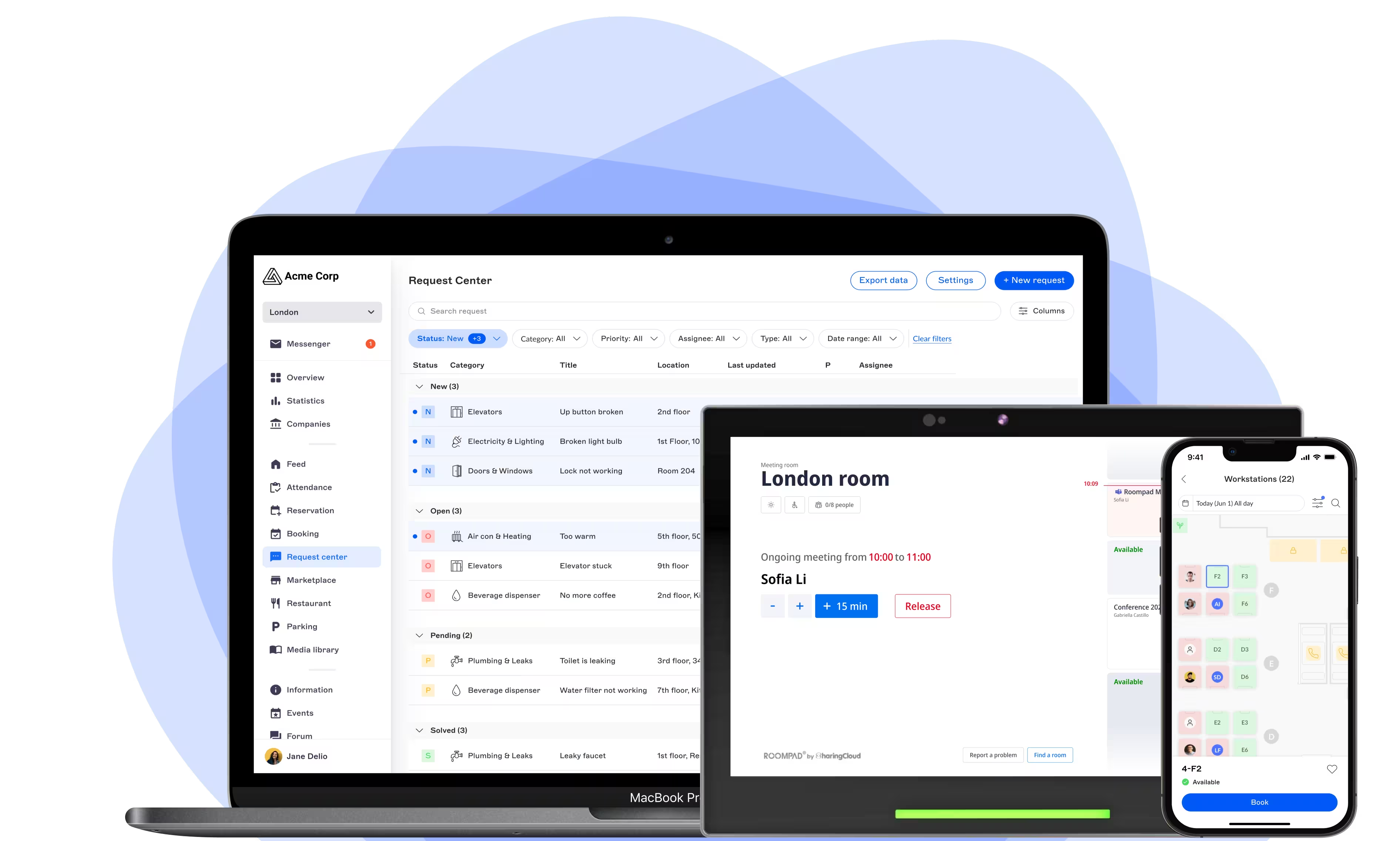
The clean design interface offers intuitive navigation, enabling employees to find what they need quickly, whether on the mobile or web application.
Regarding the consolidation of services, entities implementing the Witco all-in-one workplace experience platform will benefit from the following:
- Over 50 modules included natively in the tool, covering a wide range of functionality such as meeting room and desk booking, incident reporting, office presence, internal communication, visitor reception, concierge services, and service requests.
- A customizable marketplace that includes both internal and partner ecosystem offerings.
- An API to facilitate integration of their tools with the Witco platform
- A catalogue of over 100 applications already integrated with Witco to interface access control, catering, payment, building management systems, CMMS, sensor management services, HR information systems, among others.
The Witco model offers a flexible framework for platform evolution, tailored to align with organizational priorities and needs. Companies can progressively activate modules, beginning with the most requested services, and then extending the scope as adoption progresses. This incremental approach is designed to mitigate risks and allow for fine-tuning of the portal based on user feedback.
The workplace central platform represents far more than a simple technological tool. Centered on employee experience and operational efficiency, it breaks down silos between HR, IT, and facilities management to create smooth work environments where everyone can focus on the essential: their contribution to collective success. For large enterprises, adopting such a workplace engagement platform is an obvious choice. The emphasis is on selecting the specific services to be included and the deployment strategy.